Friday, June 15, 2018

Once Upon a Time: Comrades Lost in Korea

May 1950. Sasebo, Southern Japan.  From left: Cpl. James R. Williams, age 23, Santo, TX; 
SFC. Daniel J. Cavanaugh, age 29, Groton CT; Cpl. Russell D. Talley, age 32, Mexia, TX; 
and Cpl. Lacy C. Barnett, age 23, Empire, AL.
Although they did not know it at the time, these four young American soldiers were just weeks away from life-altering events.  An early death awaited two of them.  But in June 2018, one of them is alive and well, busily compiling a written commentary on the U.S. Army’s involvement in the opening weeks of the Korean War. More about him will follow below.

Several hundred thousand soldiers of the U.S. Eighth Army were tasked with the post-World War II occupation of the Japanese home islands. Budget austerity ensured that Army resources were optimized either for occupation duties or for war.  It could not excel at both.  

This was an idyllic garrison for young Americans in early 1950. The impoverished Japanese population welcomed these soldiers – or more specifically – welcomed their disposable income.  As members of the U.S. Army’s 34th Infantry Regiment, 24th Infantry Division, these four men were assigned to the regiment’s medical company. Based in the southern Japanese port of Sasebo, they were ten miles from the regiment’s home base at Camp Mower.

They served as medics, albeit with varying specialties such as “surgical technician” or “corpsman.” The medics’ duties included clinical support to doctors tending a litany of mundane peacetime ailments and injuries. Perhaps the most frequently encountered maladies were sexually transmitted diseases. These were sufficiently endemic to hamper the Army’s overall mission.

The sudden onset of the Korean War on June 25, 1950 would change everything for these men.  By July 5, these medics were among the 1,981 members of the 34th Infantry Regiment sent to the front lines of a “police action” to defend South Korea.  As a whole, the U.S. Eighth Army was understaffed and deficient in combat training, weaponry, and supplies. Many infantrymen entered combat with rifles that were tagged “combat unserviceable.”  

The Americans were shocked to discover that they were outmatched by the more numerous and aggressive North Korean People’s Army. The American combat strategy during the opening weeks of that war was to stall the invaders as best they could, trading land and lives for the time required to deliver additional troops and resources from the mainland U.S.

The role of a medical company was radically transformed by combat.  The corpsmen provided immediate treatment to wounded soldiers on the battlefield – and often under enemy fire. Others worked in aid stations just behind the lines, performing the initial triage of men awaiting medical remedy. Stated differently, the medical staff attended to the ghastly wounds of war, attempting to save lives, reduce potential disabilities, or shorten the wounded man’s rehabilitation times.  Per physicians’ direction, medical corpsmen carried out excruciating decisions about if, when, and how and they would treat each wounded soldier. A shortage of time, space, and supplies too often prevented or compromised the quality of care that wounded men deserved. 

The July 20 battle for the communications junction city of Taejon tragically exposed the weakness of American forces committed to the earliest days of the Korean War. After penetrating the Americans’ porous defense on the outskirts of Taejon, North Korean troops effectively infiltrated and surrounded the city. The better part of 5,000 Americans – mostly non-combatant, rear echelon troops such as medical company personnel – would have to fight their way out through Taejon’s gridwork of streets. The four medics pictured here had mixed success in escaping Taejon.  Cpl. Williams was killed in an ambush. Sgt. Talley died as the result of a truck crash after enemy marksmen killed his driver.

Both Dan Cavanaugh and Lacy Barnett survived the Korean War. They would go on to enjoy what their colleagues could not: careers, families, and time to reflect. Both men watched the American cultural landscape change over the following decades.  They saw how America changed its attitude toward soldiers, alternately reviling then embracing veterans of the Vietnam War, followed by the vacant platitudes offered to the Iraq-Afghanistan vets. But what of their old colleagues from Korea?  History would make scant record of them unless veterans themselves took the initiative.

From the mid 1980s onward, Dan and Lacy took that initiative.  Not satisfied with the official histories promulgated by the U.S. Army, they joined forces with other Korean War vets to assemble a gritty truth from a disparate collection of archival records and personal recollections.  Theirs was a race against time as the years began to take their toll.  Dan Cavanaugh passed in 1997.  Today, at age 91, Lacy Barnett is one of a handful of survivors who can provide first-hand knowledge of the chaotic days of July 1950. His vigorous research of official records has uncovered numerous permanent facts that have yet to be published. The omission of such facts from official histories, he asserts, could not have been accidental. Mr. Barnett promises that a publication, “Criminal Deployment of U.S. Forces to Korea in July 1950,” is forthcoming. 

Friday, June 8, 2018

Remembering David Douglas Duncan

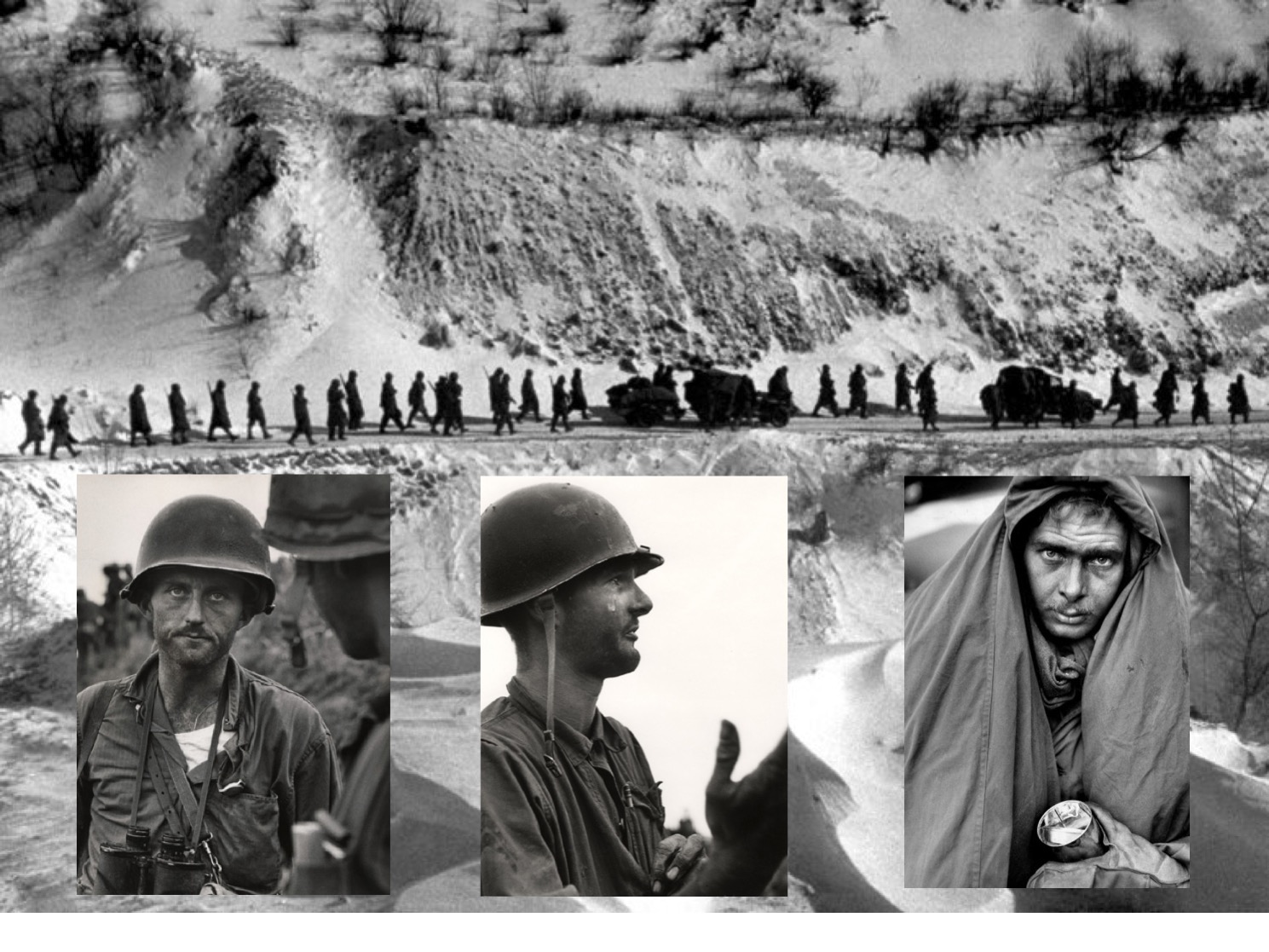
David Douglas Duncan was a gifted photographer of combat - first, as a Marine in World War II, then later for Time-Life as a civilian embedded with the Marines in Korea and Vietnam. His images came close to capturing the soul of his subjects, so that we are reminded of the human cost of  war. Mr. Duncan died in France on June 7, 2018 at the age of 102.


Shown here is a pastiche of Mr. Duncan's work in Korea.  Foreground from left: Capt. Francis "Ike" Fenton (1922-1998) on the Pusan Perimeter, Korea, September 1950; Cpl. Leonard Hayworth (1928-1950) pictured on the Pusan Perimeter on Sep. 23, 1950; unknown marine at the Chosin Reservoir, December 1950.  Background:  U.S. Marines, surrounded and out-gunned by Chinese forces at the Chosin Reservoir, "attack in a different direction" to effect their passage to Hungnam, December 1950.

Saturday, June 2, 2018

The McGovern Brothers: From Washington, D.C. to Korea ...and Back


Beyond the monuments and landmarks of Washington, D.C. are a variety of working-class neighborhoods, like the one in which Philip Thomas Hughes was raised. Most were developed between 1900 and 1940. Tourists don't usually see these little villages of shops and rowhouses, simple and cheap to build so that they were priced within reach of government bureaucrats.  Mr. & Mrs. Halsey McGovern and their six children lived in one of these homes, at 4610 New Hampshire Avenue, across from Rock Creek Cemetery. Their house was a little over four miles north of the U.S. Capitol. The McGoverns were devout Catholics who attended St. Gabriel’s Church.

With the unassuming career of a freight-rail tariff analyst, Halsey McGovern’s legacy would be unnoticed were it not for the Korean War, the tragedy that befell his family, and the headlines he generated through an unprecedented act of defiance.

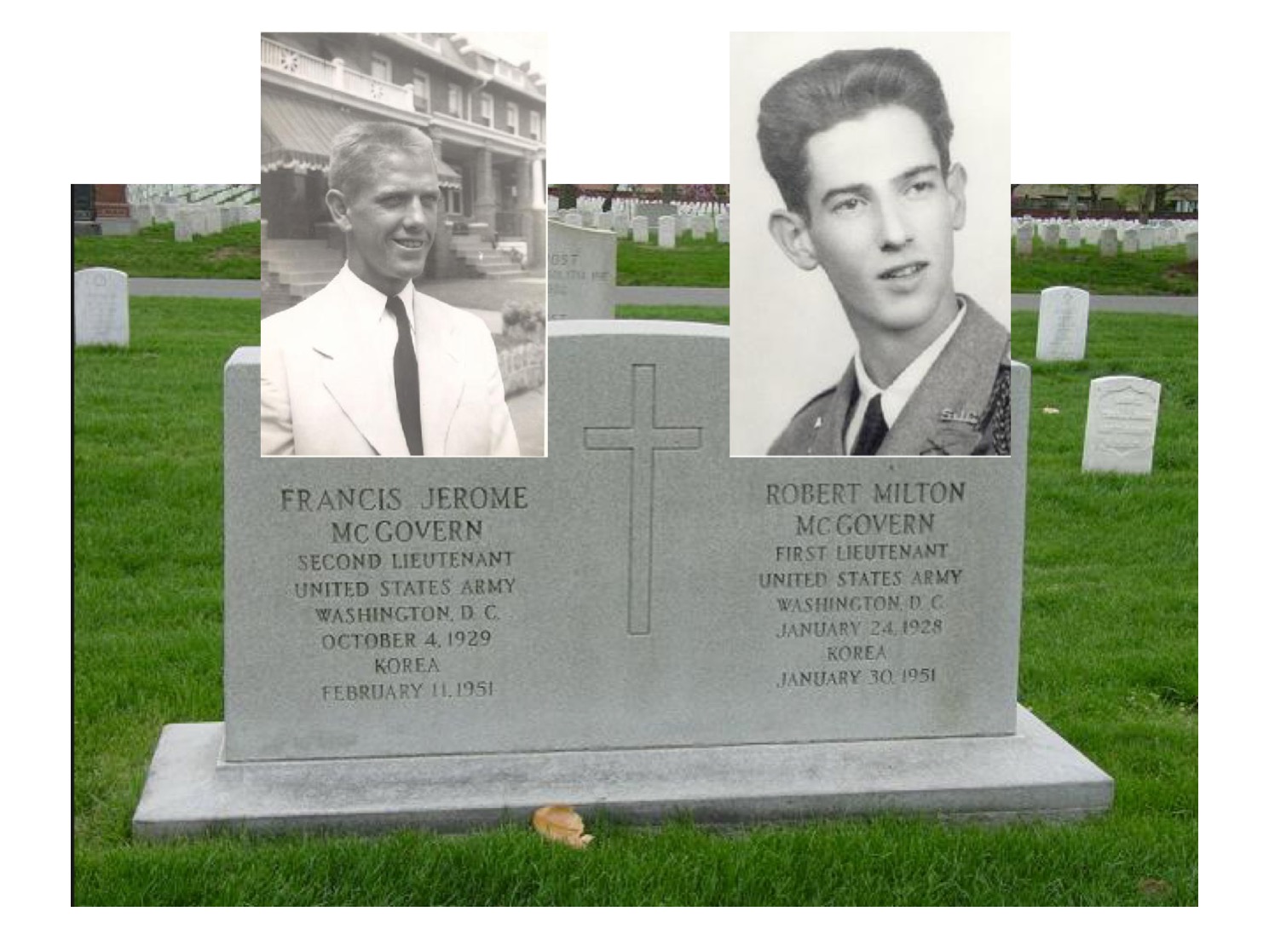
The McGovern sons attended Washington, D.C.’s St. John’s College High School, noted for its Cadet Corps. Brothers Robert (b. 1928) and Francis "Jerry" (b. 1929) were both noted for their leadership abilities, and both quickly found their vocation in the U.S. Army. By 1949, Robert was a second lieutenant with the 1stCavalry Division based at Camp Crawford in Japan, where he committed his free time and resources to support a Franciscan orphanage in Sapporo. Jerry became a platoon leader with the 2ndInfantry Division at Fort Lewis in Washington state. 

Robert and Jerome each found his way to Korea under separate commands in late 1950. Each would lead an infantry platoon. In early 1951, both were killed in action, only 11 days apart. They died the same way so many other lieutenants did; each led his platoon from the front while scaling yet another anonymous Korean hill named only by a number denoting its height in meters above sea level. 

The Army chose to posthumously decorate the brothers.  Robert’s award was the Congressional Medal of Honor.  Jerry would receive the Silver Star.  The White House pursued arrangements for President Harry Truman to present the awards to the boys’ father in January 1952.  There was one problem: Halsey McGovern, then age 65, refused to accept the medals. He stated to the Washington Post’s Ray Pittman that President Truman was “unworthy” to “confer them on my boys or any other boys.”

Halsey McGovern’s reasons for refusing the medals were not made explicitly clear.  Some strong clues are available, however. The Library of Congress maintains a file of Mr. McGovern’s correspondence, and his letters to newspaper editors are found in the D.C. Public Library’s Washingtoniana collection. These documents reveal the Tennessee-born Mr. McGovern to have been a staunch conservative, the type who perceived communist direction behind the American civil rights movement. It may be that Halsey McGovern was one of the many Americans who faulted Truman for not using atomic bombs in response to communist aggression on the Korean Peninsula. Halsey McGovern recorded such opinions for the rest of his life, until he died in 1983 at the age of 97.

The U.S. Army considers the awards to be conferred.  The actual medals are now on display at St. John's College.  Robert and Jerry McGovern are buried beside each other in Arlington National Cemetery. In May 1952, a ground-breaking ceremony began the construction of the Tenishi-in Boys Home in Sapporo, Hokkaido Island, Japan. It was dedicated to Robert McGovern.

Friday, May 25, 2018

Lt. Gen. Walton H. Walker


1950.  Korea.  Lt. General Walton H. Walker (right) had the unenviable task of taking soldiers to war in a "come as you are" fashion.  In early 1950, the U.S. Eighth Army had been configured for occupation duty in Japan.  They lacked the tactical training, stamina and motivation for combat.  America's sudden commitment to the Korean War would begin with these men under Walker's command.

At age 60, Walker's resume included everything from the VeraCruz Expedition of 1916 to serving as corps commander under George S. Patton in World War II.  While he was a stickler for polish and decorum, he also had a fondness for liquor that earned him the nickname "Johnnie Walker." All of his experience and moxie would be put to the test in Korea.

Realizing that the Army's occupation troops based in Japan were too few and ill-equipped to stop the North Korean Army's invasion of the south, Walker had no choice but to deploy his forces in a series of delaying actions.  In just under one month, the over-matched American forces were beaten back behind the 140-mile frontier known as the "Pusan Perimeter." Now with their backs to the sea, there were no more opportunities to pull back. Walker knew these beleaguered men had to hold until reinforcements could arrive from the U.S.

On July 29, Walker issued to his division commanders an order in which he demanded that there be no further retreats from the Pusan perimeter.  "We will fight as a team," he said.  "If some of us must die, we will die fighting together... I want everybody to understand we are going to hold this line.  We are going to win."

And as any decent leader should, Walker led from the front. With pilot Mike Lynch at the controls, Walker took to the air in his little L-5 liaison aircraft.  When directly over his troops, at barely more than treetop level, Lynch would throttle the plane's engine back to idle.  Walker then leaned out the passenger-side door with a bull horn in his hand, bellowing a mix of admonitions and encouragement to the troops below.

The Eighth Army held, but at great cost.  Walker would continue to command the Eighth until December 3, 1950, when he was killed after his jeep was side-swiped by a cargo truck.  After Walton Walker was buried in Arlington National Cemetery, he was posthumously promoted to full general in January 1951.

Saturday, May 19, 2018

Louis Ulrich's Unending Tour of Duty


April 23, 1951.  South Korea.  Corporal Louis Ulrich was due to go home.  He had enough rotation points after 10 months of almost non-stop combat.  As part of the first wave of American troops sent to Korea, Ulrich one of the few to survive the North Koreans’ relentless push southward to the Pusan Perimeter during the summer of 1950. Ulrich would be momentarily listed as missing-in-action in September. When the Americans’ fortunes reversed after the September 15 Inchon invasion, Ulrich participated in the headlong rush across the 38th parallel into North Korea. There, in late November, the Americans were accosted not only by massive numbers of Red Chinese troops, but also by the onset of a bitter Siberian cold front. Ulrich was wounded during the ensuing battles in March 1951. Promoted from private to corporal, Ulrich recuperated in time to resume his place on the front line when the Chinese launched their spring offensive on April 21, 1951. The U.S. Army could spare no one. Ulrich’s departure was put on hold.

Louis Ulrich and Pvt. Philip Hughes were among the 1,981 men of the U.S. Army’s 34th Infantry Regiment as they landed at the South Korean port of Pusan on July 2, 1950. After two months of ferocious combat losses, the 34th was given a 10-day hiatus in a rest camp along with the rest of the battle-weary 24th Division. By this point, only 184 members of the 34th Regiment’s original commitment were still standing. Among these were Ulrich and Hughes.

The 34th was so depleted that U.S. Eighth Army Headquarters disbanded it on September 1, 1950. The survivors were dispersed to other regiments.  Ulrich and Hughes found themselves assigned to K (King) Company of the 19th Infantry Regiment. 

Louis Ulrich was one of five brothers raised in Philadelphia.  Their home was in a rough industrial neighborhood, the kind in which the streets had embedded rail lines for freight trains. Like Philip Hughes, Louis Ulrich dropped out of high school in the late 1940s to join the Army, which added him to the peacetime occupation garrison in Japan.   

Both Ulrich and Hughes were killed in Korea.  In a sense, Hughes was the luckier of the two because he died on September 12, 1950, which spared him from months of exposure during the subsequent winter.  Plus, Philip’s remains were returned home for interment. Louis Ulrich would suffer through a full enlistment, only to be declared missing in action on April 23.  On January 4, 1954, six months after the Korean War cease-fire, the U.S. Army declared that Cpl. Ulrich was dead. This was merely a legal formality that allowed his mother to collect survivor’s benefits.  Louis Ulrich’s remains were never recovered.

Friday, May 11, 2018

Task Force Smith: "An Arrogant Display of Strength"

Elements of Task Force Smith arrive at the Taejon Train station after an overnight journey from Pusan.
SOURCE:  U.S. Army Military History Institute
Morning, July 2, 1950.  Taejon, South Korea. Spearheading the U.S. Army's initial ground force committment to Korea was “Task Force Smith,” so named for its commander, 34-year-old Lieutenant Colonel Charles “Brad” Smith, a West Pointer and a veteran of World War II’s Pacific theater. The task force predated Pvt. Philip Hughes's arrival with the 34th Infantry Regiment by only a day. Under Smith's command was a reinforced company of about 540 men detailed from the 21st Infantry Regiment with a partial complement of artillery. 

The composition of this force reflected the need to move quickly – by air – which in turn was restricted by Korea’s rough airfields, which quickly deteriorated under the weight of heavily-loaded aircraft. For practical purposes, then, Task Force Smith was lightly equipped. Over half the troops were under the age of 20 – soldiers, yes, but generally undertrained and unprepared.

As long as their opponents lacked superior troop numbers and armament, Task Force Smith was expected to provide an effective roadblock to the North Korean incursion. A formation under an American flag would, in MacArthur’s words, pose “an arrogant display of strength” from which North Korean troops would supposedly recoil in fear. MacArthur’s tacit hope was that the enemy would perceive the few Americans initially deployed in Korea as the vanguard of the vast military juggernaut that had won World War II. 

The North Koreans were neither fooled nor intimidated by the meager force of Americans they  encountered. 

Having already taken Seoul, the capital of South Korea, the North Korean People’s Army advanced southward toward Osan on July 5. Just north of there, Task Force Smith, the front line of American resistance, was dug-in on a couple of rain-soaked hilltops. Almost 5,000 NKPA troops advanced on this position behind a spearhead of over 30 top-notch Russian-built T-34 tanks. The few American weapons that could effectively stop tanks were quickly neutralized. The experienced and battle hardened NKPA forces poured around and through the Americans, killing some, capturing others, and causing a panicked rout of the remainder. The dazed survivors fled south, leaving behind equipment and wounded men that they could not carry. 

Some 40 percent of the task force was lost – either killed, captured, or wounded. In return for their efforts, Task Force Smith delayed the NKPA advance for approximately seven hours. Their roadblock gave Philip Hughes and the 34th Regiment time to set up a line of defense to the south at P’yongt’aek. 

Friday, May 4, 2018

The Ghost of Akeji "Norman" Morinaga


On Tuesday, September 12, 1950, U.S. Army Private Philip Hughes queued up with a squad of men to conduct a reconnaissance patrol in the South Korean wilderness west of Hill 300, near Kyongju.  Among his colleagues was Corporal Akeji "Norman" Morinaga, of Hawaii. The men of this patrol were ambushed by North Korean forces.  None of the Americans came back alive. 

Since recounting Philip Hughes's story in The Battle of Turkey Thicket, I keep finding shreds of documentation describing the people and events related to that dramatic time.  Only recently did I find this photo of Cpl. Morinaga.  His story is reconstituted mostly from digital newspaper clippings.  I had the good fortune of locating and corresponding with Cpl. Morinaga's niece, Gwen.  She graciously gave me some additional info. It is from all these sources that we encounter the "ghost" of Cpl. Morinaga.

Akeji was Nisei, that is, a first-generation American born of Japanese immigrants.  Eager to serve his country, the Hawaii native enlisted in the U.S. Army in March 1945 at the age of 19, and received basic training at Schofield Barracks. Shortly after, Akeji signed up for linguistics duties, which necessitated his travel to the continental U.S., arriving at Ft. Snelling in St. Paul, Minnesota. With the end of World War II, however, the need for Japanese language interpretation all but disappeared.  No matter - Akeji apparently liked the Army and decided to re-enlist.  He learned the quartermaster trade, and in 1946, found himself managing supply logistics in Kobe, Japan, on behalf of the Army's occupation forces.  It was there that Akeji found a bride who eventually bore him a son.

While Akeji enjoyed this idyllic billet, the Korean War began in June 1950.  The U.S. Army found itself woefully unprepared to conduct war in many ways, not least of which was adequate manpower.  "Operation Flushout" was the Army's effort to gather rear-eschelon men who, regardless of occupational specialty, would become infantrymen bound for Korea with the stroke of a pen.  This explains Cpl. Morinaga's arrival at the base of South Korea's Hill 300 during the rainy night of September 8-9.  Here, he was assigned to Pvt. Philip Hughes's K Company, 19th Infantry Regiment. Only days later, both met their fate on patrol.

Cpl. Morinaga's remains were recovered and buried in Hawaii's National Memorial Cemetery of the Pacific. Many years ago, his grown son came to Hawaii to visit for the first time with his father's American family. Today, a great nephew bears the name "Akeji Morinaga," serving today in the Hawaii Army National Guard. Incidentally, Hawaii sacrificed more men in the Korean War (on a per capita basis) than any other U.S. state or territory.